


Six thousand islands
Greece
About 200 of its 6,000 islands are inhabited, so the ferry map plans the trip. On the mainland: the Acropolis and Delphi.
Mark the countries in Europe you have been to, and see how many of the 52 you have covered.
0/524327
countries & territoriesUN member statesEU member states
0%
of Europe
Map colours
Theme
Your colours
for light mode Åland
 Albania
 Andorra
 Austria
 Belarus
 Belgium
 Bosnia and Herzegovina
 Bulgaria
 Croatia
 Cyprus
 Czechia
 Denmark
 Estonia
 Faroe Islands
 Finland
 France
 Germany
 Gibraltar
 Greece
 Guernsey
 Hungary
 Iceland
 Ireland
 Isle of Man
 Italy
 Jersey
 Kosovo
 Latvia
 Liechtenstein
 Lithuania
 Luxembourg
 Malta
 Moldova
 Monaco
 Montenegro
 Netherlands
 North Macedonia
 Norway
 Poland
 Portugal
 Romania
 Russia
 San Marino
 Serbia
 Slovakia
 Slovenia
 Spain
 Svalbard and Jan Mayen
 Sweden
 Switzerland
 Ukraine
 United Kingdom
 Vatican
No country found.
0 of 9 earned
Every European country you mark brings you one step closer to the next milestone, and marking every country in a region earns that region’s badge.
Every badge earned: all of Europe, all four regions.
0on your bucket list
Travel recommendations from forty European countries: the most visited countries in Europe, the ones on the rise, and hidden gems far from the crowds. Every country you've already been to drops out, so you only see places that are new to you. Found one you like? Add it to your bucket list.
Six thousand islands
Greece
About 200 of its 6,000 islands are inhabited, so the ferry map plans the trip. On the mainland: the Acropolis and Delphi.

Cliffs and sea fog
Faroe Islands
Eighteen islands of grass-roofed villages, sheer cliffs and weather that turns by the hour. Two hours from Copenhagen and like nowhere near it.

Mountains meet the sea
Montenegro
The Bay of Kotor winds between walled towns and mountains that drop straight into the water. Inland, the Tara canyon is the deepest in Europe.

Trains to the peaks
Switzerland
Glacier lakes, the Matterhorn and a railway that climbs to 3,454 metres at the Jungfraujoch. One pass covers almost every train, boat and bus in the country.

The oldest republic
San Marino
Three towers on the cliffs of Monte Titano, with views across Romagna to the Adriatic. Founded, it says, in 301, it is the oldest surviving republic in the world.

Most World Heritage sites
Italy
More UNESCO sites than any other country. Rome, Florence and Venice in the middle, the Dolomites in the north, Sicily in the south.

Transylvania and the delta
Romania
Fortified Saxon villages, the painted monasteries of Bucovina and Bran Castle in the Carpathians. Where the Danube meets the Black Sea, its delta is one of Europe’s largest wetlands.

Fjords and midnight sun
Norway
Fjords reach up to two hundred kilometres inland, and in Lofoten the fishing villages sit beneath sheer peaks. North of the Arctic Circle the sun does not set in midsummer.

Sun and Moorish south
Spain
Warm coasts and quiet islands, with Granada’s Alhambra and Barcelona’s Sagrada Família inland. The Canaries stay mild all winter.

Gorges and casemates
Luxembourg
The capital is built over river gorges and miles of fortress tunnels, with the Grund quarter on the water below. Public transport across the whole country is free.

Alps to Riviera
France
Beaches, ski slopes, vineyards and Paris, all a few hours apart by train. It has been the world’s most visited country for over thirty years.

Bridges and mountains
Bosnia and Herzegovina
Mostar’s rebuilt bridge, Sarajevo’s bazaar, and rivers the colour of glass between them. Cheap, green and closer than it feels.

Alps in miniature
Slovenia
A lake with an island church, the limestone of Triglav, and the Adriatic ninety minutes away. The whole country is smaller than Wales.

Slopes and concert halls
Austria
Some of the best-served ski areas in the Alps in winter; Vienna’s palaces, museums and concert halls for the rest of the year.

Prizren and Rugova
Kosovo
Prizren’s Ottoman old town sits below a hilltop fortress, and the Rugova gorge has some of the best hiking in the Balkans. Few visitors yet, and some of the warmest welcomes in Europe.

Castles and beer
Czechia
Prague’s medieval centre came through the wars largely intact, and the Bohemian countryside around it is studded with castles. Czechs drink more beer per head than anyone on earth.

Baroque and dunes
Lithuania
Vilnius has one of the largest old towns in eastern Europe, and Trakai’s island castle is a short trip away. On the coast, the Curonian Spit carries the highest drifting dunes in Europe.

Fire and ice
Iceland
Waterfalls, glaciers and black sand within a day’s drive of the airport, and the aurora from September. Go before or after the summer, which is now packed.

Atlantic edge
Portugal
Lisbon and Porto are small enough to walk. The Douro valley makes port, the Algarve gets the sun and the west coast gets the surf.

Lake and old town
North Macedonia
Ohrid is one of Europe’s oldest lakes with a Byzantine town on its shore, at the prices of thirty years ago. Matka’s canyon is forty minutes from the capital.

Adriatic sailing
Croatia
A thousand islands along one narrow coast, so much of the country is seen by boat. Inland, the lakes and waterfalls of Plitvice.

Tatras and castles
Slovakia
The High Tatras pack alpine peaks and glacial lakes into a range only twenty-six kilometres long. Below them, Spiš Castle is one of the largest castle complexes in central Europe.

Coast and stone towns
Albania
Ottoman hill towns at Berat and Gjirokastër, and an Ionian coast that costs a third of the one across the strait. The Accursed Mountains in the north are still walking country.

Cities close together
United Kingdom
London, Edinburgh and Bath are short train rides apart, and the Scottish Highlands begin where the cities stop.

Rivers and late nights
Serbia
Belgrade’s fortress looks over the meeting of the Sava and the Danube, and its river clubs stay open until dawn. In the south, medieval monasteries hide in green valleys.

Castles and Christmas markets
Germany
Castles above the Rhine, the Alps in the south, and Berlin unlike either. From late November the Christmas markets are reason enough.

Lakes and Lapland
Finland
Some 188,000 lakes and about three million saunas for five and a half million people. In Lapland the northern lights appear on around two hundred nights a year.

Temples and clear water
Malta
Three small islands with temples older than the pyramids and Valletta, the fortress city of the Knights of St John. The water around Gozo and Comino is among the clearest in the Mediterranean.

The Wild Atlantic Way
Ireland
A coast road of 2,500 kilometres past the Cliffs of Moher, the Ring of Kerry and Connemara. Most evenings on it end in a pub with live music.

Art nouveau and forest
Latvia
Riga has the greatest concentration of art nouveau buildings in the world. Beyond it, half the country is forest, edged by nearly five hundred kilometres of quiet Baltic beach.

Bikes, canals, tulips
Netherlands
Flat, small and built around the bicycle. Amsterdam’s canals and museums come first; in April and May, the tulip fields.

Cellars and quiet
Moldova
Wine cellars measured in kilometres, a cave monastery above the Răut, and the least-visited country in Europe. That last part is the appeal.

Old town and bogs
Estonia
Tallinn’s walled old town is one of the best preserved in northern Europe, two hours by ferry from Helsinki. Half the country is forest, crossed by boardwalks over raised bogs.

Baths and the Danube
Hungary
Budapest’s thermal baths, its ruin bars and a parliament that lights up the Danube at night. Lake Balaton, the largest in central Europe, is a short train ride away.

Monasteries and mountains
Bulgaria
Rila Monastery hides in the mountains south of Sofia, and Plovdiv, one of Europe’s oldest cities, still stages concerts in its Roman theatre. Prices are among the lowest in the EU.

Old towns, low prices
Poland
Kraków’s medieval square survived the war and Gdańsk was rebuilt to match. The Tatra mountains take care of the south.

Ghent and the Ardennes
Belgium
Ghent has the canals and guildhalls of Bruges with a fraction of the day-trippers, and the Ardennes fill the south with castles and forest. Then there are the beer, the chocolate and the fries.

Islands and Lapland
Sweden
Stockholm is built on fourteen islands, with thirty thousand more in the archipelago beyond. In the far north, Abisko is one of the best places on earth to see the northern lights.

Bikes and harbours
Denmark
Copenhagen is built for the bicycle, and its harbour is clean enough to swim in. Beyond the capital lie thatched villages, the Viking ships at Roskilde and the dunes of Skagen.

A country of mountains
Andorra
Wedged between France and Spain, with the largest ski area in the Pyrenees and hut-to-hut trails all summer. It has no airport and no railway station.
You have been to all forty, the famous ones and the quiet ones alike. Time to look beyond Europe.
You have been to every country in this list. Try another one.
Free and private: all 52 countries of Europe on one interactive map, with no account, no app and nothing uploaded.
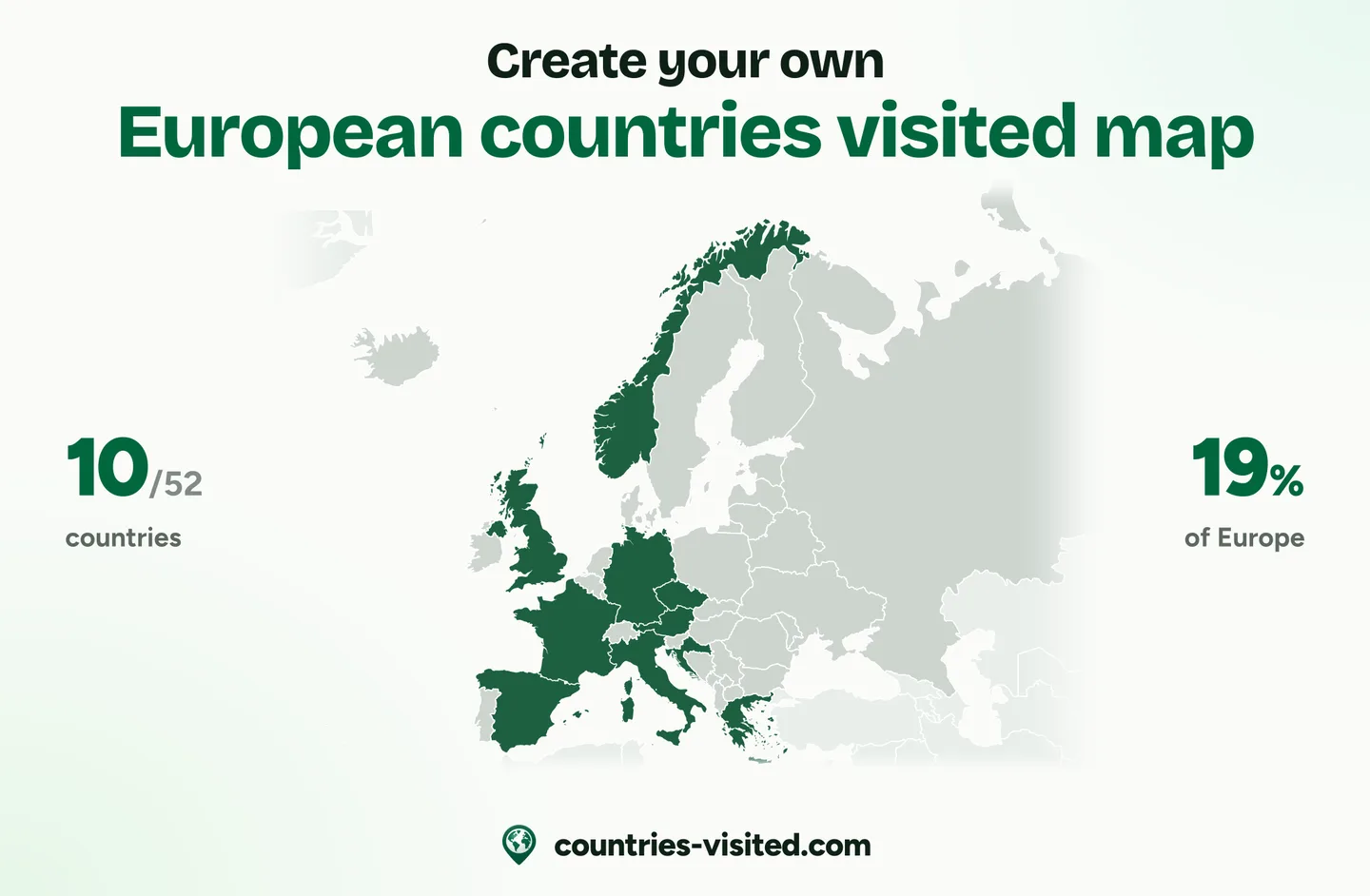
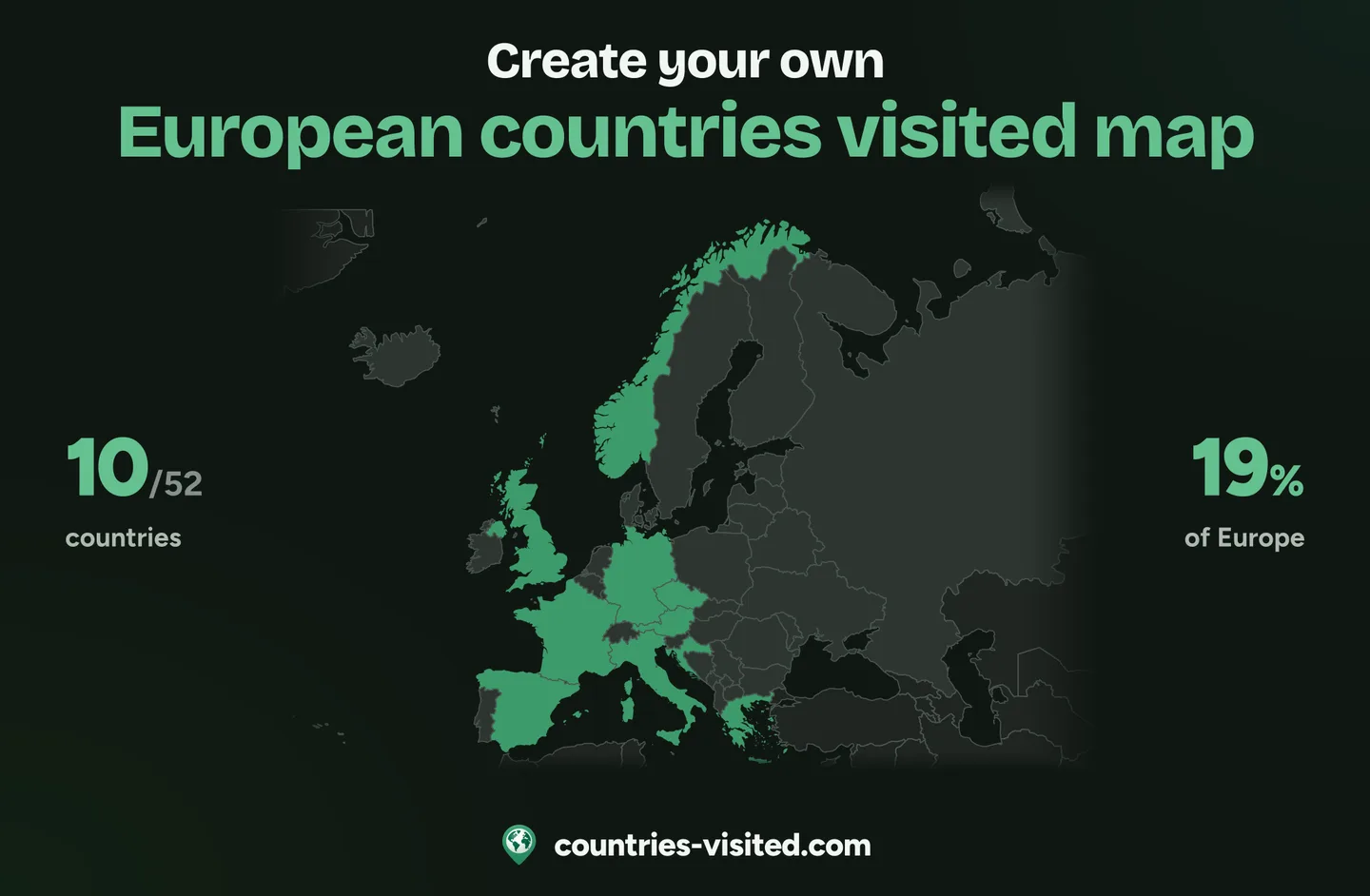
Click any of Europe’s 52 countries and it fills in at once, from Iceland to the Urals. Monaco, San Marino and Vatican City are one search away in the list, and every country you mark here is marked on the world map too.
A live count out of 52, your share of Europe and a progress ring grow with every country you mark. Filter the list by Northern, Western, Southern or Eastern Europe, or count only the 27 EU member states or the 43 UN members.
Your marks travel in the link itself: one URL opens your whole map of Europe for anyone you send it to. Share it after your next Interrail trip, or download the map as an image ready to post.
Short answers to the questions people ask most.
Click every country in Europe you have visited on the map, or tick it in the list, and the counter above the map adds them up as you go, out of 52. The ring beside it shows your share of Europe, and the badges further down fill in as you complete each region.
Fifty-two places: 44 countries, from Russia to microstates such as Vatican City, San Marino, Monaco, Liechtenstein and Andorra, plus Kosovo and seven territories such as Gibraltar and the Faroe Islands. Set the count above the list to “EU member states” to tally only the 27 countries of the European Union.
Nine of the 52. Vatican City, whose Holy See is a permanent observer, and Kosovo, whose independence Serbia does not recognise, are not members, and neither are seven territories: the Faroe Islands, Åland, and Svalbard and Jan Mayen, which belong to Denmark, Finland and Norway, the British overseas territory of Gibraltar, and the Crown Dependencies of Jersey, Guernsey and the Isle of Man. Set the count above the list to “UN member states” to tally only the other 43. Your marks on the nine are kept and count again when you switch back.
Geographically, Cyprus lies in Asia, off the coasts of Turkey and Syria, so it is not one of the 52 places this map counts and is drawn in the muted context tone. Politically, it is a full member of the European Union. So with the count set to “EU member states”, Cyprus can be marked and counts as one of the 27; under every other setting it is left out. On the world map, Cyprus counts as a country in Asia.
Countries outside Europe are drawn for geographic context only. They keep coastlines and borders readable but are not part of this map’s tally, so they cannot be clicked.
Not on this map. Only about 3% of Turkey lies in Europe: Eastern Thrace and the European half of Istanbul. Ankara and the rest of the country are in Asia, so Turkey is greyed out here as context, like Georgia, Armenia, Azerbaijan and Kazakhstan; on the world map all five count as countries in Asia. Russia is the other way round: most of its land lies in Asia, but its capital and most of its people are west of the Urals, so it counts as one of Europe’s fifty.
Yes. The Europe map and the world map share one list, so a country you mark on either one is marked on both. Resetting this map clears only its European countries.