


France
102.0M arrivals
France was the most visited country in the world in 2025, with 102.0 million international arrivals, ahead of Spain and the United States of America. Below: all twenty, ranked and mapped, with what each one is known for.
1.52bn
international trips worldwide
+4%
more than in 2024
11/20
of the top 20 in Europe
102.0M arrivals


96.8M arrivals


68.3M arrivals
The twenty, shaded by arrivals: the darker the green, the more international visitors. 11 of them are in Europe, so Europe gets a closer look.
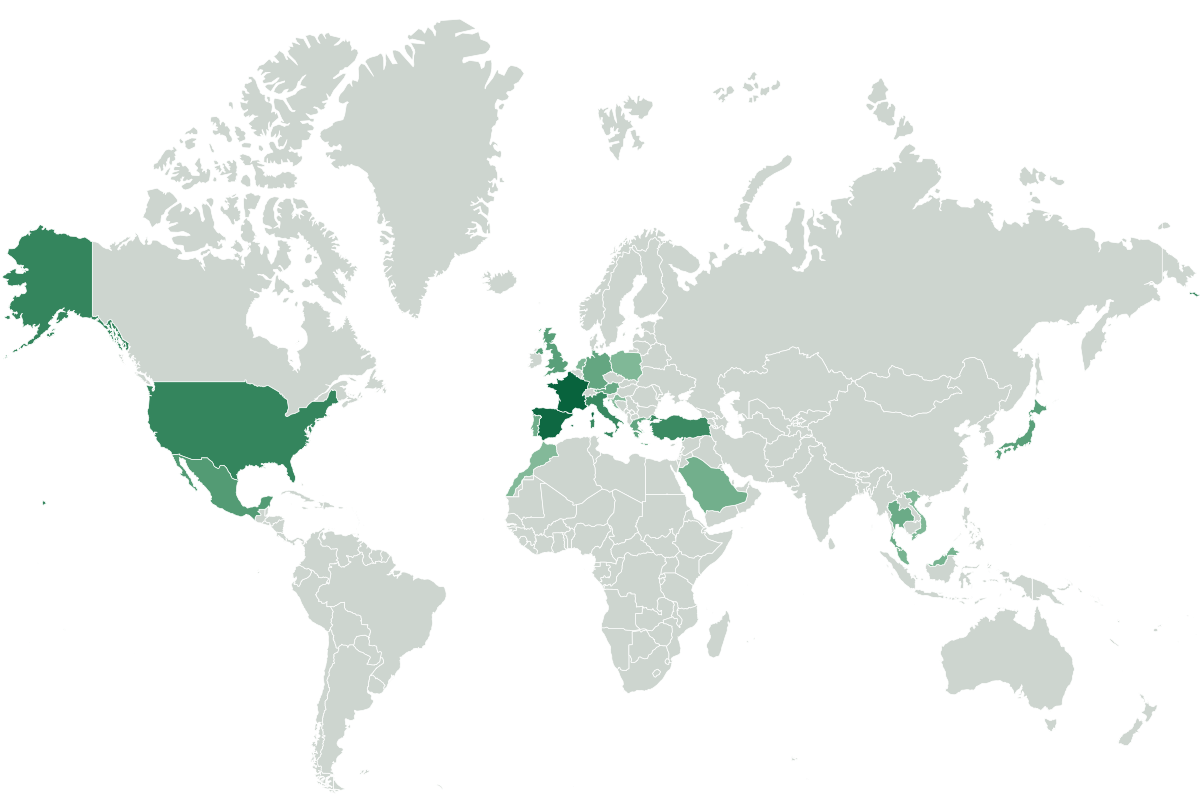
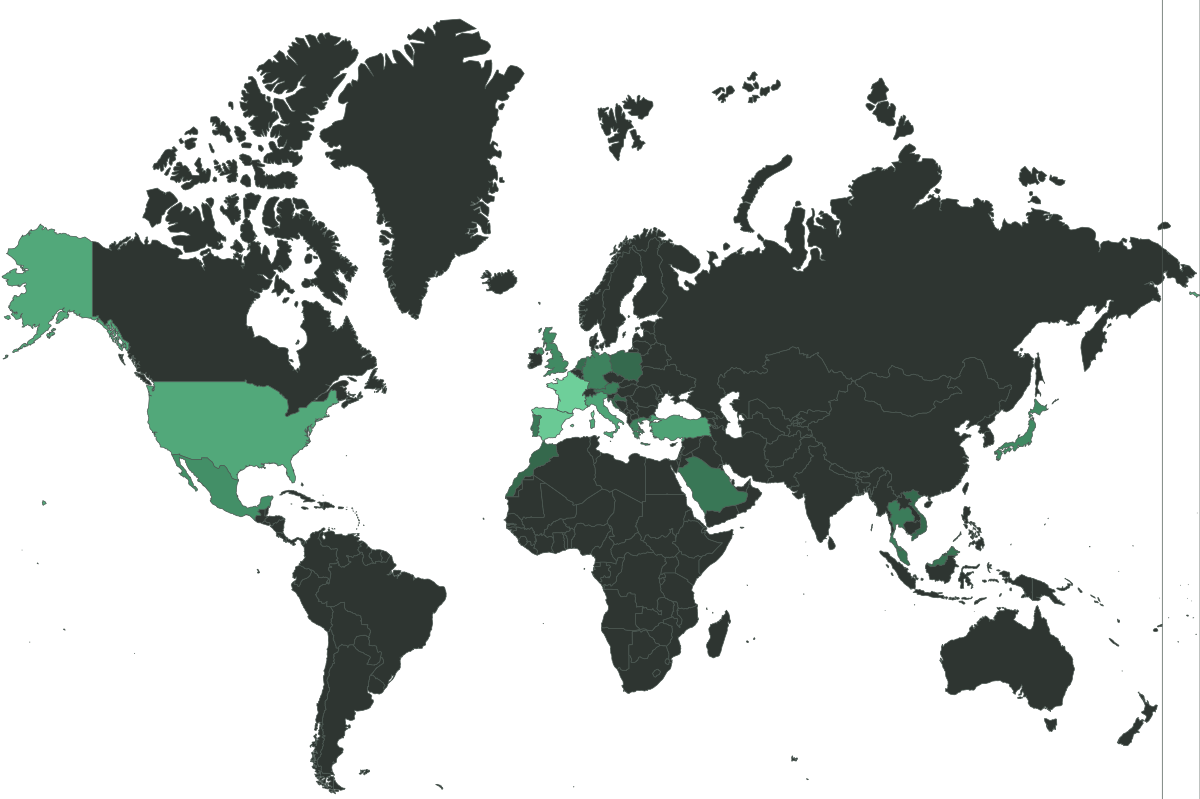
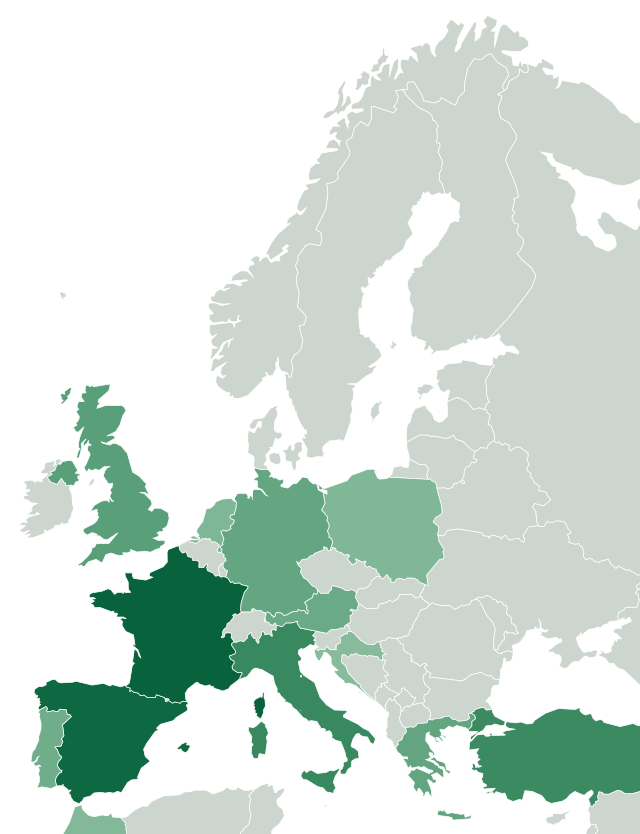
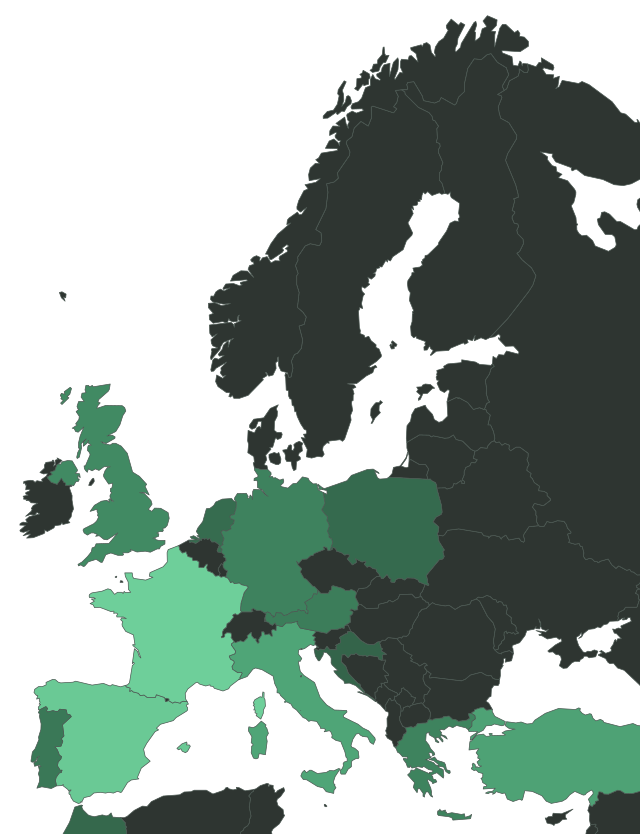
International arrivals, 2025
Ranked by international tourist arrivals. Each bar is the green the map gives that country, and its length is a share of France’s 102.0 million.
France102.0MSpain96.8MUnited States of America68.3M Italy65.8M
 Turkey63.9M
 Mexico47.8M
 United Kingdom43.6M
 Japan42.7M
 Greece38.0M
 Germany37.1M
 Austria33.5M
 Thailand33.0M
 Portugal29.9M
 Saudi Arabia29.3M
 Malaysia26.6M
 Netherlands22.3M
 Poland21.4M
 Vietnam21.2M
 Morocco19.8M
 Croatia17.6M
Visit three countries on one trip and each of them counts you once. That’s why small neighbouring countries score so well.
Not every country counts the same way. Some count people at the border, others count hotel guests, and Greece leaves cruise passengers out.
So don’t read too much into small gaps. A million more can come from how a country counts, not from more people going there.
Sources: UN Tourism (January 2026) and each destination’s own 2025 statistics. Compiled August 2026.
Tap the countries you’ve been to on an interactive world map and watch your count grow. Free, no sign-up.
The ranking measures traffic. Here is what draws the crowds to each country, when to go, and what it is known for.
No. 1
Alps to Riviera
Paris brings most first-time visitors, but France holds the top spot through variety: ski resorts in the Alps, the beaches and lavender of Provence, and the vineyards of Bordeaux and Burgundy, all a few hours apart by fast train.
No. 2
Sun and Moorish south
Sun is the main draw: the Costa del Sol, the Balearics and the Canaries, which stay warm all winter. Barcelona, Madrid and the Moorish south around Seville and Granada fill the rest of the trip.
No. 3
Parks and road trips
Many arrivals cross by land from Canada and Mexico. Visitors from further away head for New York, Florida and California, or plan a road trip through the national parks of the West.

No. 4
Most World Heritage sites
No country has more UNESCO World Heritage sites. Rome, Florence and Venice anchor most first trips; the Amalfi Coast, the Dolomites and Sicily are why people come back.

No. 5
Two continents
Istanbul spans two continents, and its mosques and bazaars are a trip on their own. Further south come the cave hotels and balloon flights of Cappadocia, the ruins of Ephesus and the resorts of the Antalya coast.

No. 6
Ruins and two coasts
Most visitors fly to Cancún and the Riviera Maya, with Maya sites such as Chichén Itzá and Tulum within a day trip. Mexico City and Oaxaca draw those who come for the food, which UNESCO lists as cultural heritage.

No. 7
Cities close together
London draws most visitors, with free national museums and West End theatre. Trains reach Bath, York and Edinburgh in a few hours, and the Scottish Highlands begin where the cities stop.

No. 8
Temples and bullet trains
Tokyo’s neon and Kyoto’s temples are just over two hours apart by bullet train. Cherry blossom in spring and red leaves in autumn are the busiest weeks of the year; in winter, Hokkaido’s powder snow takes over.

No. 9
Six thousand islands
Most visitors come for the islands: about 200 of some 6,000 are inhabited, and Santorini, Mykonos and Crete take the largest share. On the mainland, the Acropolis in Athens and the ruins of Delphi.

No. 10
Castles and Christmas markets
Berlin, Munich and the castles of Bavaria draw most visitors, with the Rhine valley and the Black Forest close behind. From late November, Christmas markets fill the old towns.

No. 11
Slopes and concert halls
Vienna’s palaces, coffee houses and concert halls fill the year. In winter, the Alps of Tyrol and Salzburg hold some of Europe’s best-served ski areas, and Salzburg’s old town adds Mozart.

No. 12
Islands and street food
Bangkok’s temples and street food come first, then the islands: Phuket and Krabi on the Andaman Sea, Koh Samui in the Gulf. In the north, Chiang Mai is cooler and quieter.

No. 13
Atlantic edge
Lisbon and Porto are small enough to walk, and the Douro valley that makes port is a short trip upriver. The Algarve has the beaches, Madeira the mild winters.

No. 14
Newly open
Tourist visas only began in 2019, and many visitors still come for the pilgrimages to Mecca and Medina. Leisure travellers head for AlUla, where Nabataean tombs are cut into sandstone, and for the Red Sea coast.

No. 15
Rainforest and hawker food
Kuala Lumpur’s towers and Penang’s hawker stalls on the peninsula; across the sea on Borneo, rainforest where wild orangutans still live. Many arrivals come overland from Singapore.

No. 16
Bikes, canals, tulips
Amsterdam’s canals and museums come first, and the rest of the country is a short train or bike ride away: Rotterdam’s architecture, Utrecht, the windmills of Kinderdijk. In spring, the tulip fields.

No. 17
Old towns, low prices
Kraków’s medieval square survived the war, and Gdańsk was rebuilt to match. Warsaw, the Tatra mountains in the south and prices well below western Europe’s complete the trip.

No. 18
Karst bays and lanterns
A long, narrow country best travelled from north to south: Ha Long Bay’s limestone islands, lantern-lit Hoi An in the middle, the Mekong Delta at the end. One of the fastest-growing destinations on this list.

No. 19
Medinas and desert
About three hours’ flight from much of Europe and nothing like it: the walled medinas of Marrakech and Fes, the High Atlas behind them, and the Sahara dunes beyond.

No. 20
Adriatic sailing
More than a thousand islands along one narrow coast, so much of the country is seen from a boat. Dubrovnik and Split have the walled old towns; inland, the lakes and waterfalls of Plitvice.
Tap the countries you’ve been to on an interactive world map, watch your count grow, and share the map. Free, with no sign-up.
Short answers to the questions people ask most.
France, with 102 million international arrivals in 2025 according to Atout France. It has held the top spot for more than thirty years, helped by sitting at the centre of western Europe, where a large share of its arrivals are people passing through towards Spain, Italy or the Mediterranean coast.
About 1.52 billion, some 60 million more than in 2024 and 4% up on the year, according to UN Tourism’s World Tourism Barometer of January 2026. Europe alone accounted for 793 million of them.
Because arrivals reward short international hops. Travelling between European countries means crossing a border every few hundred kilometres, while a comparable journey inside the United States is domestic and never counted. US arrivals also fell 5.5% in 2025, the first decline since 2020.
Not on this page: it is a reference ranking. The interactive world map on the front page is the one that keeps a tally of where you have been.