


Bavaria
102.9M overnight stays
Bavaria was the most visited German state in 2025, with 102.9 million overnight stays, ahead of Baden-Württemberg and North Rhine-Westphalia. Below: all sixteen, ranked and mapped, with what each one is known for.
497.4M
overnight stays in Germany, a record
192M
guest arrivals in 2025
1/5
of all nights were spent in Bavaria
Bavaria
102.9M overnight stays


Baden-Württemberg
58.7M overnight stays


North Rhine-Westphalia
55.5M overnight stays
All sixteen, shaded by overnight stays: the darker the green, the more nights. Bavaria stands alone, with nearly as many as the second and third together; Bremen and Saarland, the two smallest states, close the list.
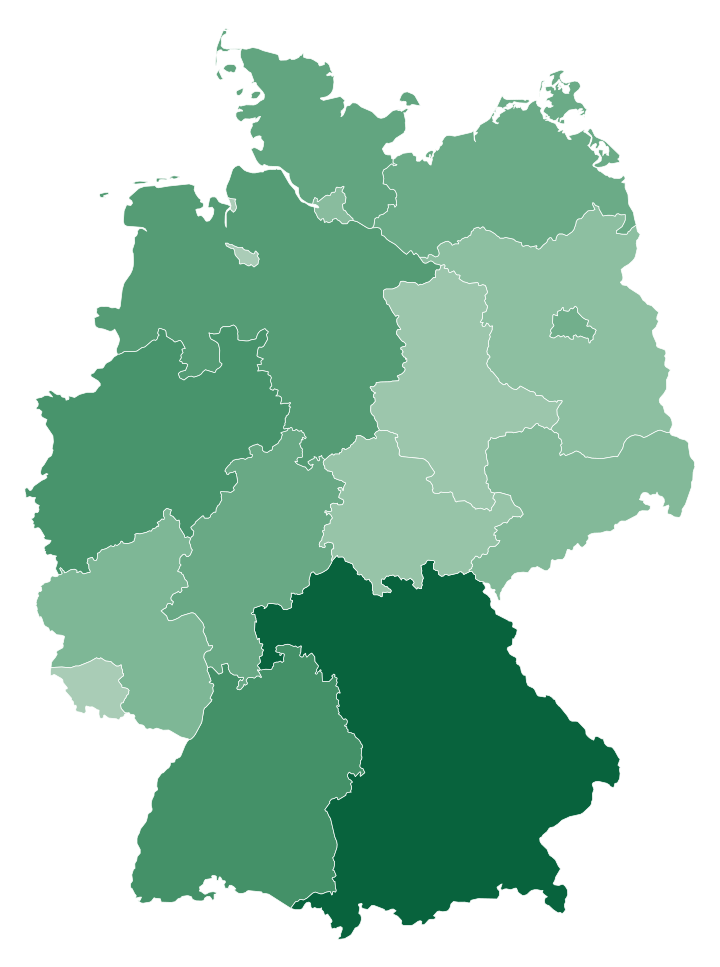
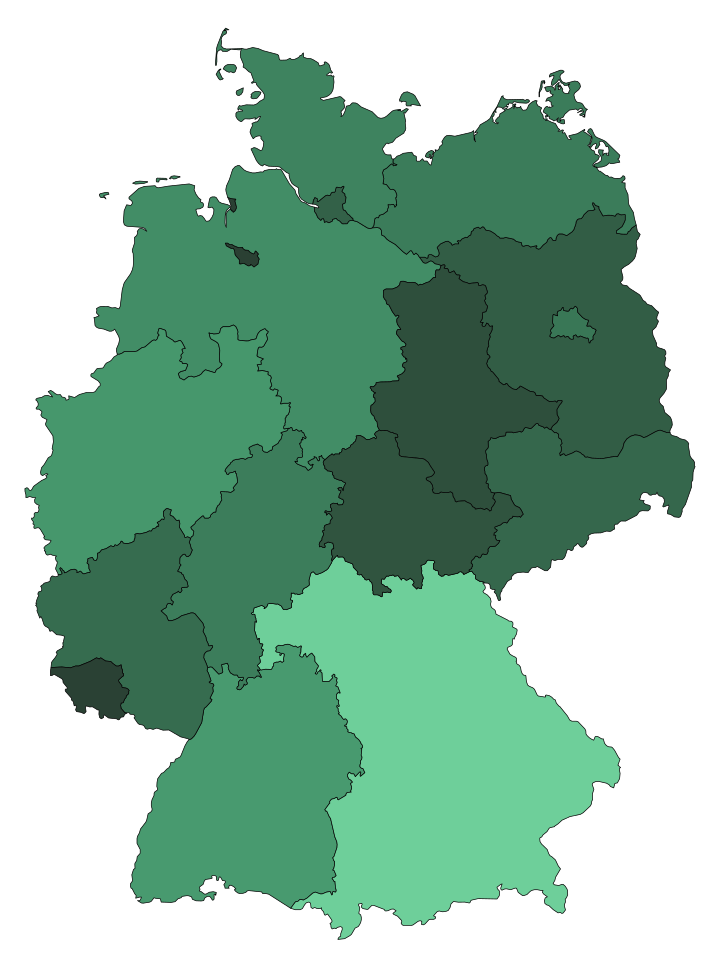
Overnight stays, 2025
Ranked by overnight stays. Each bar is the green the map gives that state, and its length is a share of Bavaria’s 102.9 million.
Bavaria102.9MBaden-Württemberg58.7MNorth Rhine-Westphalia55.5M Lower Saxony46.9M
 Schleswig-Holstein38.6M
 Hesse34.3M
 Mecklenburg-Western Pomerania33.3M
 Berlin29.4M
 Rhineland-Palatinate22.6M
 Saxony19.7M
 Hamburg16.5M
 Brandenburg14.3M
 Thuringia10.1M
 Saxony-Anhalt8.2M
 Saarland3.3M
 Bremen3.0M
The figures count nights, so a week on the Baltic counts seven times and a weekend in Berlin twice. That lifts the holiday regions of the coast and the Alps above the cities.
About 83% of the nights were spent by guests who live in Germany. Visitors from abroad accounted for 83.6 million nights, led by the Netherlands, the United States and Switzerland.
Only hotels, guesthouses, holiday homes and campsites with at least ten beds or pitches are surveyed. Small holiday flats are not: the booking platforms alone reported 68.3 million nights in holiday flats and houses, most of them outside this count.
Sources: Federal Statistical Office (Destatis), monthly tourism survey 2025: overnight stays in accommodation establishments by federal state, as published by the German Tourism Association (DTV) in “Zahlen, Daten, Fakten 2026”. Compiled November 2026.
Tap the states you’ve been to on an interactive map of Germany and watch your count grow. Free, no sign-up.
The ranking measures nights. Here is what draws visitors to each state, when to go, and what it is known for.
No. 1
Alps and castles
Munich is the gateway, for its museums, beer halls and the Oktoberfest, and from there the trip runs south to the lakes and peaks of the Alps and King Ludwig’s castles. Further north, Nuremberg, Bamberg and Regensburg keep their medieval old towns, and the Bavarian Forest is the quiet side of the state.
No. 2
Black Forest and lake
Most trips take in the Black Forest, with its spa towns, farmhouses and winding high roads, and Lake Constance, where ferries cross to Switzerland and Austria. Heidelberg and its castle are the classic stop on the way, and Stuttgart adds the Mercedes-Benz and Porsche museums.
No. 3
Cathedral and coal
Cologne and its cathedral draw the most visitors, followed by Düsseldorf’s riverside old town and the trade fairs of both cities. The Ruhr has turned its collieries and blast furnaces into museums, concert halls and parks, and Aachen and Münster add a cathedral and an old town worth the detour.

No. 4
Heath and tidal flats
Families come for the North Sea: the seven East Frisian Islands, most of them car-free, and guided walks across the tidal flats of the Wadden Sea. Inland, the Lüneburg Heath and the Harz mountains are for walking, and Hanover, Celle and Goslar for a day in town.

No. 5
Between two seas
It is a beach holiday on two coasts: the wide, windy North Sea with Sylt, Föhr and Amrum, and the calmer Baltic with its resorts around the Bay of Lübeck. Lübeck’s old town, the home of marzipan, and the sailing city of Kiel are the stops in between.

No. 6
Skyline and fairy tales
Many visitors land in Frankfurt for business or a trade fair and stay for the museums along the Main and the cider taverns of Sachsenhausen. An hour away, the Rheingau’s vineyards slope down to the Rhine, Wiesbaden keeps its spa-town elegance and Kassel has the hillside park of Wilhelmshöhe.

No. 7
Chalk cliffs and lakes
Almost everyone comes for the Baltic: the islands of Rügen and Usedom, the white resort architecture of Binz and Heringsdorf and beaches lined with wicker beach chairs. Behind the coast, the Mecklenburg Lake District is for houseboats and canoes, and Schwerin’s castle sits on an island of its own.

No. 8
Capital of reinvention
Visitors come for the history on every corner, from the Reichstag’s glass dome to Checkpoint Charlie and the memorials of the divided city. They stay for the museums, the neighbourhoods of Kreuzberg and Prenzlauer Berg and the clubs, and Potsdam’s palaces are half an hour away by train.

No. 9
Rivers, castles, wine
The classic trip follows the rivers: by boat or train through the Middle Rhine gorge, with a castle on almost every bend, and along the Moselle from one wine village to the next. Trier has the best Roman remains north of the Alps, and the Palatinate’s Wine Route runs through vineyards and almond trees.

No. 10
Baroque and sandstone
Dresden is the main draw, for the rebuilt Frauenkirche, the Zwinger and the art collections of the Saxon electors, and Leipzig follows with its music and its trade-fair past. Walkers and climbers head for the sandstone of Saxon Switzerland, and in winter the Ore Mountains are the home of German Christmas crafts.

No. 11
Gateway to the world
A city break on the water: harbour boat tours past the container terminals, the Elbphilharmonie’s public plaza and the warehouse canals of the Speicherstadt. The evenings belong to the Reeperbahn and the musicals, and Sunday morning to the fish market.

No. 12
Palaces and waterways
Most visitors come out from Berlin: to Potsdam for Sanssouci and its parks, or to the Spreewald to be punted through its canals. The rest is lakes, pine forest and quiet villages, made for cycling, paddling and swimming.

No. 13
Castle and classics
A state of small towns with large names: Weimar for Goethe, Schiller and the Bauhaus, Eisenach for the Wartburg and Bach, Erfurt for its cathedral hill and the inhabited Krämerbrücke. Between them the Thuringian Forest is walking country, and the bratwurst is a matter of pride.

No. 14
Timber frames and Luther
The Harz draws the most visitors, for the steam railway up the Brocken and the timber-framed towns of Quedlinburg and Wernigerode. Further east the trip turns to history: Luther’s Wittenberg, the Bauhaus in Dessau and the cathedrals of Magdeburg and Naumburg.

No. 15
The Saar loop
Germany’s smallest area state sits against France and Luxembourg, and its kitchens show it. Visitors come for the view of the Saar loop, the Völklingen Ironworks and Saarbrücken’s baroque squares, and walkers for the looping premium trails through the forest.

No. 16
Hanseatic and small
Bremen is a compact old town for a day or two: the market square with its town hall and Roland, the crooked lanes of the Schnoor and the brick fantasy of the Böttcherstraße. Downriver, Bremerhaven adds the Emigration Center and the Klimahaus on the harbour.
Tap the states you’ve been to on an interactive map of all 16 Bundesländer, watch your count grow, and share the map. Free, with no sign-up.
Short answers to the questions people ask most.
Bavaria, with 102.9 million overnight stays in 2025 according to the Federal Statistical Office, far ahead of Baden-Württemberg with 58.7 million and North Rhine-Westphalia with 55.5 million.
Bremen, the smallest state, with 3.0 million overnight stays, just behind Saarland with 3.3 million. Saxony-Anhalt, with 8.2 million, and Thuringia, with 10.1 million, come next. Hamburg, a single city, counted 16.5 million.
Mecklenburg-Western Pomerania: about 21,200 overnight stays for every 1,000 inhabitants, more than three times the national average of about 6,000. Schleswig-Holstein follows with about 13,000, and North Rhine-Westphalia, the most populous state, has the fewest, about 3,100.
497.4 million, a record and 0.3% more than in 2024, from 192.0 million guest arrivals. With 37.1 million arrivals from abroad, Germany was also the tenth most visited country in the world, as the world ranking shows.
Not on this page: it is a reference ranking. The interactive map of the German states is the one that keeps a tally of the Bundesländer you have been to.